Thursday, 10 March 2016

Work in Progress : Warhammer 40K Salamanders Fire Raptor Gunship

I realize I haven't posted anything regarding my own painting for some time now.  In fact, I haven't posted much of ANYTHING lately, but "Works in Progress" posts have been especially lacking on Sable and Spray.

Just to prove that I haven't completely abandoned painting minis myself, here are a few pics of one project that's currently on my painting desk, a Warhammer 40K Forgeworld Salamanders Fire Raptor Gunship:


Now this is a pretty sizeable kit.  Not Titan sized, mind you, but still much bigger than most vehicle kits I get to work on.  For a vehicle kit junkie like myself, that makes it extremely enjoyable to paint.

Best of all, it came all pre-assembled.  I'm doing this up as a commission paintjob for a friend of mine, and he prepped, cleaned, assembled, and primered the model himself.  That is a huge project unto itself, as Forgeworld resin kits are very labour-intensive.  Many parts come warped, and need to be gently bent back into shape with the application of a little heat (blow dryers or with warm water).  Others have horrible casting issues, and practically need to be re-sculpted by the modeller.  There are often fitting issues, air bubbles, and other nasty problems that also need to be fixed before painting.  Parts also often need to be degreased thoroughly, otherwise the residual mold release coating will reject paint and primer.  In short, Forgeworld kits are a labour of love, and an exercise in extreme patience.

I am VERY thankful that I got to skip that step.

Matthew did a fantastic job of putting this model together.  Yes, there are still some mold lines here and there, and ample evidence that there was judicious use of an exacto knife on parts.  But nothing I can't compensate for with some well placed weathering and painted on battle scars, which will only add to the realism.  On the whole, the model was built very well, and there are no loose pieces looking like they will break away any time soon.


Knowing that I was going to paint this for his Salamanders Space Marine army, I picked up some Vallejo Model Air paints from my local hobby shop.  I wanted to be able to do as much work as I could with the airbrush, and purchasing the Model Air paints meant that I wouldn't have to mess around with paint thinners and mixing quite as much as I normally do with standard model paints.

The two above pics show the amount of work I was able to do with just the airbrush.  Now, airbrushing isn't quite as much of a time saver as some would think.  With a standard sable brush, there is no time spent masking off areas in case of overspray.  There is also a minimum amount of time spent cleaning your tools.  You don't have to mess around with respirators to make sure you don't inhale a bunch of atomized paint and thinners.  Generally, I don't use the airbrush unless I can help it.  I much prefer blending paints by hand.  Yes, it takes longer to do the shading and highlighting if you want the same quality of smooth transitions, but when you add in the prep work and cleaning, it's often faster and less stressful to just do the work by good old fashioned sable brush.  However, in this case we're talking about a good amount of green real estate, so it was worth it.

Notice that the paper towel below the model is decorated with plenty of different shades of green.  One of the big differences with airbrushes is the lack of feedback from the tool.  You can see how the paint looks in the cup, but that's not necessarily how the paint will look coming out of the tip.  Test spraying onto another surface not only gives you a better sense of what's going to happen on the model (before you apply to the model), but it also preps your fingers to better understand what amount of pressure you need to apply, and how far back you need to pull, in order to get the result you want.

Another thing to consider is that not everything needs to get masked.  Sometimes when I'm painting near the final edge of something, simply turning the model at a sharp angle to the airbrush means that any overspray won't hit other parts of the model.  Any time you can get away without masking, is a huge time saver.

Now, while this was a good start, I still have a long way to go with the green areas.  That's when I put away the airbrush, and pick up the sable brush.


I'm now working up some blended highlights with my trusty Kolinsky sable brushes.  I'm working in some P3 Thrall Green (the bottle can be seen in the bottom left of the pic), which is a bone linen beige colour, with just a tiny hint of green in it.  That makes it ideal for highlighting the green armour plates.  You can tell that it's already starting to bring out the detail better, and simulates how the light would reflect off a "real life sized" assault gunship.  I'll also need to go in there with the shading to accentuate the contrasts a bit more later.

Have a look how I'm trying to place the shadows of one armour plate right next to the highlights of the next.  This technique / approach is called, "colour modulation", and it maximizes contrast and visual interest.  While heavily stylized (and not entirely realistic), it's a necessary approach to a model that you intend to weather later.  Weathering tends to flatten out contrast quite a bit, and so you absolutely need to exaggerate contrasts ahead of time in order to compensate for this.


The plan is to blend some more shading in, in order to deepen the contrasts.  I will also add a little bit of edge highlighting in order to simulate how light likes to catch on the hard edges of large plates.  This is a nice touch when used in conjunction with a decent blending job and nice gradated highlights and shading... NOT when overdone and used all alone (as I described in this past article).

One thing I did find interesting was how the P3 Thrall Green acted on my wet palette.  While primarily beige in colour, that little touch of green had a tendency to separate as the paint got saturated with water.  Thin it too much and then turn your back on it for awhile, and the green would break free and "float" to the surface.


That's the watered down Thrall Green on the top right, full strength Thrall Green on top left.  The Vallejo Model Air paint in green is to the bottom left, and mixes of the two are in the centre and bottom right.

By the way, paints that are pre-thinned to work in airbrushes (such as the Vallejo Model Air line) are a bit harder to work with on the palette and with a standard sable brush.  They start off rather runny, and have no real body to work with.  They seem to be a lot like a glaze in consistency, only powerfully pigmented.  I could see two-brush blending them straight from a dry palette, but using them on a wet palette was a constant challenge in controlling their consistency.

Speaking of brush blending, I'm alternating between Mathieu Fontaine's "push-pull" method of blending, and Meg Maple's "two brush blending".  I have been fortunate enough to attend both their classes, and those were two amazing techniques I took away with me.  With them, I have been able to slowly improve my blending to the point where I can work them into airbrushed transitions without too much notice.

Lots more to do, and that's only for the green areas.  After that, I've still got to do the glass canopy, the metal areas, some freehand work, and plenty of weathering.  If I'm really a sucker for punishment, I may even paint all those rivets...

As always, comments, questions, and criticisms are always welcome.

Monday, 7 March 2016

Quick Tip : Use Zip Ties to Keep Your Tools From Rolling Off the Table

Lately, I've been reading a LOT of home renovation books and magazines, as we have finally managed to purchase a house.  It's an older one (built in the mid '50s... if you are European, go ahead and laugh.  To us North Americans, 60+ years for a house is OLD), so there's lots of renos to do.

Anyway, I came across this neat little tip in an issue of Family Handyman magazine:


After reading this, I had one of those moments of, "Holy crap!  How did I NOT think of this before?"

After posting this up on the Vancouver Miniature Painters and the Eavier Metal Facebook pages, I had hundreds of "likes", and numerous comments saying pretty much the same thing.

I can see this working for plenty of miniature related tools, from exacto knives, to sculpting tools, to paint brushes, etc.  Basically anything that is barrel shaped and tends to roll if set down on a sloped surface.

I probably would use the smallest zip ties I could get my hands on though.  Larger ties would add more weight (not much, but still...), which may affect the balance of the tool somewhat.  It wouldn't be a big deal after awhile, but initially you would have to become accustomed to the shift in the balance point.

Anyway, worth a try for anyone who's ever been annoyed by rolling tools.

Thursday, 11 February 2016

TMM (True Metallic Metallics) vs NMM (Non Metallic Metallics) : Which Do I Like Better?


Coke versus Pepsi.  Ford versus Chevy.  Metal versus Punk.  These are the eternal debates of our time.  And now TMM versus NMM ranks right up there with the rest of them, at least for Miniature Painters.

First of all, what the heck is "TMM" and "NMM"?

"TMM" is short for "True Metallic Metallics", and in miniature painting, it's the use of metallic paints to represent metallic surfaces.  Most "metal" paints have a bit of colour pigment in the body of the paint, but also have ultra fine flecks of metal suspended in them as well, in order to give the paint its metallic shine or sheen.  The better the quality of paint, the more finely ground the metallic flake, which makes for a smoother appearance when dry (conversely, cheaper paints have course grind flakes, which makes them much rougher in appearance, almost pebbly).

"NMM" is short for "Non Metallic Metallics", which refers to the technique of simulating shine without actually using shiny paint.  The paints used are often matte finish, but by utilizing maximum contrast and a few other mind games to trick the eye, the viewer reads the painted miniature as "ooh... shiny".  There are no metallic flakes or pigments, but we are somehow given the strong impression of a metallic surface.

Up until the 21st Century, there was no debate.  We pretty much all used metallic pigmented paint.  I personally have fond memories of such classic GW staples as "Boltgun Metal", Chainmail", and Mithril Silver".  There were also metallic paints in bronze and gold as well, and even ones in rusty, weathered tones.

Application was very straightforward and simple.  Most of the time, we applied a dark or mid tone of metallic paint, gave it a ink wash for shading, and then highlighted with a brighter version of the base coat.  If you wanted to use a cruder, quicker method, you would simply drybrush over a black undercoat in successively brighter layers of metallic paints.  If you wanted to really take your time for a more polished look, you would thin out your metallic paints a bit on a palette, and gradually build up smooth transitions of blended metallics (just as you would with a non-metallic paints on a non-metallic area).

Classic GW 'Eavy Metal paintjob from the end of the 20th century.  This is what we all aspired to paint like.

Metallic paints had / have different painting characteristics to non-metallic paints.  They tended to dry very smooth and slick, so ink washes worked exceptionally well on them.  A rough slap dash of black wash of the right consistency would run right into the crevices of the model's detail in a very predictable manner.  But the drawback of metallic paints is that if you thinned out your paint too much, the body of the paint would quickly loose cohesion and you'd get very patchy results when it finally dried.

When light falls on a model painted with metallic paints, it reflects off the metallic pigments, and thus you have a realistic shine.  The manner in which ambient light hit the surface created the majority of the contrast our eyes and brains needed in order to read it as metal.  Straightforward and simple.  We didn't even call it "TMM" at the time, as it was pretty much the only way to paint metal areas (and "TMM" as we know it today is actually something very different to what I've just described... which I'll explain in a little bit).

So, life with metallics was good, right?  Well, we all thought so, until an upstart rogue French miniatures company came along and upset the balance of the Force.

Classic Rackham / Confrontation paintjob.  While the NMM looks a little flat by today's standards, it was mind blowing at the time.

Rackham had a miniatures game called, "Confrontation", and produced some of the most beautiful miniatures we'd ever seen up to that point (in my opinion, some sculpts still stand as some of the best... ever).  The proportions were different to what we'd seen up until then (no oversized hands and feet, and blades and wrists and ankles were not made chunkier to withstand the rigours of gaming like GW did at the time).  Stylistically, the sculpts were more akin to something in between Asian anime / manga and euro comic book art too.  And the miniatures had an almost ethereal flow to them... even though the models were static, the way the clothes draped and wrapped around the subjects gave the viewer the strong impression that the model was in caught in motion.

But what really blew our minds was the radically different approach to painting that the Rackham studio painters used.  It was as if they had no prior experience with traditional miniature painting methods, and instead took conventional and heavily stylized 2d canvas and comic book art techniques and training to the 3d models.  They really looked like the cover art of all the fantasy games and novels that had come before, especially when viewed in the pages of a magazine or on a computer screen.

Google "Boris Vallejo and Julie Bell" if you ever need a NMM reference.  Their 2D art features it in spades.

"NMM", or "Non Metallic Metallic" was the biggest challenge to traditional miniature painting.  I have no idea of how that term was even coined, or who was primarily responsible for coming up with it.  All I know is that the seemingly ridiculously contrary term gained immediate traction.  Seriously... calling something "Non Metallic Metallic" is like calling a veggie burger a "Non Meat Meat Patty".  It's not a particularly well thought out or elegant definition, yet it somehow gets the message across.

Still, as a snobby former English Lit student, I'd like to beat the guy who came up with "NMM".  Seriously buddy, WTF?

I'm not going to turn this article into a NMM tutorial, as there are plenty of those online, in print, on DVD, and on Youtube.  What I can do is define what it is (see above), and generally how it works.

The difference between NMM and simply painting something grey or brown (steel or gold / bronze) is maximizing contrast to simulate light reflection.  And precise and thoughtful placement of where your highlights and shades go is key. 

Maximizing contrast is the "easy" part, in a sense.  Any part painted in NMM will have pure matt black (or at least very close to it) as the lowest point of it's spectrum of colour, and pure white (or at least very close to it) as it's highest zenith.  Really the hardest part is being able to cram in every mid-tone inbetween, blending as smoothly as humanly possible to ensure no chunky transitions.

Where you place your highlights and shades is also a big part of maximizing contrast.  Every black point has to contact a white point.  Black against white are polar opposites, so your eyes read the contact between them as a sharp contrast.  So, instead of highlighting the peak of a bevelled sword dark to light, and then light to dark once you go over the edge of it, you would go dark to light, and then as soon as you cross the peak of the bevel, you'd go dark to light again so that the light part contacts the dark whenever possible.

Pic pulled off the Tutofig website. Fantastic example of how dark is carefully placed in direct contrast with light, and how smooth blending is key.

The painter can then add interest in the areas between the extremes.  While you may do various tones of grey to simulate steel, and tones of brown to yellow to simulate gold or bronze, you can also add subtle glazes of other colours too.  Blue works well when glazed into the shades of NMM steel, for example, as it simulates the blued effect of some metals.  If you're truly ambitious, you can glaze in a similar colour to the areas surrounding and facing the metal areas, to simulate the metallic surface's reflective properties (the "mirror finish|, so to speak).  If you really want to go '80s airbrush mural art style, you can even work on developing your "SENMM" (Sky Earth Non Metallic Metallic) where you simulate a chrome mirror finish, and the surrounding earth and sky horizon reflecting off of it.

Mini painters call this effect, "SENMM".  Normal people call this, "Chrome effect".  We mini painters are NOT normal people...

Gah, this is starting to turn into a tutorial article now, and I try to avoid those when possible.  Let's get back on track...

"TMM" or "True Metallic Metallics" as we know it now, came about years and years later after NMM started to lose its novelty and wow factor (not to say that it was any less impressive... just that it wasn't "novel" any more).  People were pushing the boundaries of NMM into ridiculous areas, just to impress the masses (SENMM being the most obvious example).  I definitely admire that drive to expand the horizons of miniature painting, but I was just so happy when TMM came along, as it truly was something unique to mini painting as an art form.

NMM may have been relatively new to mini painting, but it was well established in canvas and 2 dimensional art.  It's what people did since the first caveman started scratching drawings on the side of his man-cave.  It's in comic book art, it's in computer animation, it's in commercial art, and it's even in historical art.  You simply don't use metallic flake paint for those things, so you simulate the illusion of a metallic surface using NMM.


NMM looks fantastic in pics, as you are forced to view the model from the exact angle that the photographer chooses.  Thus it looks, "right" when viewed as intended (this is sometimes called, "forced perspective").  As it should be, as you are essentially viewing a 3 dimensional model in 2 dimensions.  However, the paintjob doesn't always look quite as good when viewed in person, as you are now able to view it in ways the painter never intended.

Think of it this way: What we build and paint are solid, three dimensional sculptures.  They can be viewed from all sorts of angles by your eye when held in your hand, sitting in a display case, or on the gaming table.  However, when you take a picture of it, and viewed on a computer screen or in print (a 2 dimensional surface), you have flattened that 3 dimensional model into a flat 2 dimensional impression of the original piece, much like a piece of canvas art or comic book page.  Thus, it only makes sense that a 2 dimensional painting technique "works" when you are viewing a model reduced to a 2D impression.

I'm sure Rackham knew this when they embraced NMM.  Most people around the world would never get a chance to see those models "live" and in person.  They would only see pictures of those models.  Of course those models would look very artistic and painterly, and evoke feelings and impressions of classic fantasy and comic book art... after all, they were painted using the same painting techniques used by those artists!

Of course, this is not to devalue NMM at all.  It's a damn hard technique to pull off (much easier once you've got the hang of it, but definitely difficult to master in the first place).  And it looks amazing... less so in person, but not by much.  It's still awe-inspiring to see a well done NMM piece in hand, but primarily because of the incredible and buttery smooth blending work involved, and the thought processes (care and attention) put into the model.

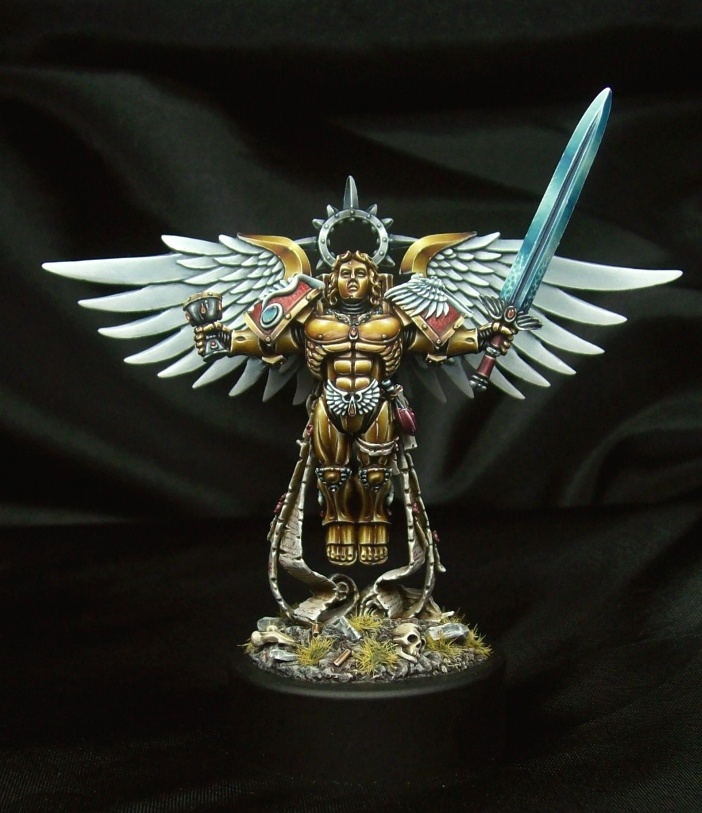
One of the most influential NMM works of all time, Darren Latham's Sanguinor.

And his NMM has only gotten better over time, as evidenced by this WIP Stormcast.

I think anyone who is still reading this article by now, and hasn't yet quit and started surfing pics of Megan Fox by now will start to get the feeling that I'm more of a TMM man (and more of a fan of Kate Beckinsale too).  I definitely don't hate NMM... I just think that TMM is a bit more versatile, as it looks slightly better in person (in my opinion).

Did someone mention Kate Beckinsale??

So what is "True Metallic Metallic" anyway?  Well, put simply, it's very nearly the same as NMM, only done with metallic pigmented paints.

Whaaaaa???  How the heck does that work?

Well, you have the extreme contrasts of NMM, but with the real shine and reflection (and not JUST the impression of it) of a real metallic surface afforded by using micro-metallic flake paint.  You still have to put some thought into placement of your highlights and shading, in order to ensure that the extremes butt up against each other for maximized contrast.  However, you can also play with the contrast of shine vs dull, by making sure your dark areas have little to no reflection (a matt glaze of black or other shade colour usually works for this).

A quick Google search pulled up this pic.  It perfectly illustrates the use of NMM techniques with "true" metallic paints, to achieve fantastic TMM.

With the latest generation of quality metallic paints, the metallic flakes are ground so fine as to be nearly imperceptible as grains, thus giving the dried paintjob a smooth shiny finish.  When carefully blended (as opposed to coarsely layered or haphazardly drybrushed on), they give a really nice, fairly realistic result that is still just as "artistic" and "painterly" as NMM.

TMM : Combining shine AND contrast!

You can also apply coloured glazes to TMM to simulate reflection, just as you would with NMM.  You can imply rust, dents, wear, bluing, chrome, etc, just as effectively as you would with NMM, but it requires additional work (just like you would with NMM).  

The problem with TMM is that the term encompasses just about every approach to painting with metallic paints... the good and the bad.  When done carefully, with all the same attention and thought as most NMM paintjobs, it's a thing of wonder.  When slapped on like house paint, sprayed on from a rattle can, or drybrushed on with a large drybrush, it's damn ugly. The end effect is overly reliant on the natural shine of the metallic pigments in order to achieve contrast, and many people dislike TMM for this reason... badly done and with little control, the effect is left to chance.

Painted back in the same decade that brought us piano-key skinny leather ties, and Samantha Fox singing, "Boom boom boom, let's go up to my room...", I guess this would be a good example of me executing what could technically be called, "TMM", before I knew any better.

Control is also marginally more difficult with metallic paints.  If you thin them too much, the metallic pigments have a hard time binding together, and the paint "breaks".  I find that mixing a tiny bit of medium in helps with this, but there are still limits to how far you can push a metallic paint.

Lastly, photographing TMM is not as straightforward as taking pics of NMM models.  With NMM, you know which angles are the best to photograph from, and light does not bounce off the model in unpredictable ways.  With TMM, the lighting used will actually reflect off the model, creating contrasts and shine that may be picked up by the camera in ways the human eye wouldn't.  Luckily with digital photography, you can simply take multiple pics from different angles, and discard the pics that didn't turn out as well as you liked.

So, which approach do I personally prefer?

At the moment, it's TMM.  I believe that with the right amount of thought and technique applied, TMM has many of the same characteristics of NMM (contrast is precisely controlled, and the effects are planned), but more accurately resemble METAL when viewed in person.  It's not an "artistic interpretation" of what metal should look like, but rather, it IS metal... a form of metallic medium, in any case.

I'm not as concerned with the piece looking good on a computer screen or in the pages of a publication.  Most of my models are meant to be appreciated in person, by the human eye.  I paint for competition, where the judge will see the model for themselves, and I have no control over which angle he/she looks at the piece.  I also paint to play with the models, and the angle and distance you view the models is nothing like the angle and lighting conditions under which models are photographed.

I'm kind of simplifying things a bit when I contend that NMM is better for photography, and TMM is better in person.  Generally, this is true, but there are many examples of NMM models that look fantastic in person, and TMM models that look fantastic in photos.  Try both methods for yourself, and see which works better for you.  But I urge you to master both techniques, as the skills and techniques involved in both easily transfer over to other areas of your painting, and will make you a stronger painter overall.

Plus, that way you will have two tools in your tool chest of skills, rather than just the one.

Wednesday, 3 February 2016

Bottlecaps as Painting Tools: Not Just for Fallout Any More...


It seems like all my gaming buddies are talking about Fallout 4, all the time.  While I haven't succumbed to the urge yet (heck, I haven't even replaced my XBox 360 and PS3 for the latest versions, and my PC would probably struggle to run Donkey Kong or Pac Man), I fondly remember collecting bottle caps as currency in the earlier versions of the game.

Thinking about Fallout inspired me to do a quick writeup about one of my favourite painting tools, the humble bottle cap.  While not a hardcore drinker by any stretch of the imagination, I do enjoy a good craft brewed beer with dinner every so often.  While I started drinking beer back in my university days (really crappy mass brewed stuff... Budweiser, Molson Canadian, and Molson Dry mostly), when the craft beer scene started taking off locally in the late '90s, I started expanding my drinking range, and found myself actually enjoying beer for its own sake, rather than just as a social lubricant.  My business partner in Sorcerer Studios (my old miniature painting studio) and I would often each nurse a bottle of the good stuff on particularly long work days (a nice light hefeweizen during a hot summer day, or a rich dark porter or stout on a cold winter day), and when my brother-in-law became a brewmaster, that pretty much cemented my appreciation of quality beers (he even had a beer named after him).

And so, returning to the topic of bottlecaps and how they relate to painting, I seem to have plenty of them at hand whenever I need them.  Granted, some are dented or warped a tiny bit from prying them off the neck of the bottle, but they are still perfectly serviceable.  People who drink beers from a can may not have a good supply of them, but they don't have any taste to begin with in my opinion (beer from a can tastes like licking the inside of a metal pipe... it's shit.  Craft brewers know this, which is why quality beers are not sold in cans).

So how do you use a bottlecap for painting?  The most common use that I've found for them is as a throwaway painting palette.

Have you ever seen the type of dry painting palette that has spoon-like divots in it? 


They are there to contain runny paints, and keep them from trying to get nasty with your other colours.  If I'm mixing watery inks, glazes, and washes, I may grab a bottlecap and mix my colours inside one.  Once it's done, I toss the cap.

I also use it for mixing oil paints.  Thinning oil paints to find just the right consistency requires mixing it with some sort of thinner (linseed oil, as an example).  It comes from tubes in a consistency thicker than toothpaste, which sucks for painting miniatures.  Mix in a little linseed oil, and you've got yourself something you can work with.  After I'm done with that colour, I toss the cap.

Bottlecaps are also great for "portion control" of glues, mediums, and other liquid substances.  When basing, I often squeeze a bit of white glue into a bottlecap, and then use a dropper to add some water to it.  Swirl a ratty old brush in there to mix it up and thin it to the exact consistency that you're looking for, and simply toss the cap away afterwards.


I've mixed up modelling snow in them (usually either baking soda or Secret Weapon crushed glass and clear resin water effects).  I've filled them like tiny cups with liquid brush cleaner and swirled my brushes in them to get all the old paint residue off them.  Thinning brush on primer or brush on clearcoat can be accomplished inside a cap.  I've also mixed plaster in them, and other modelling mediums too.

In fact, for just about anything you want to use, but you figure is best to keep away from the paints on your regular palette (dry or wet), I suggest using an upturned bottlecap.  Disposable AND renewable (so long as you enjoy good beer), what's not to like?

On a similar note, perhaps I should write a companion article regarding the many uses of wine bottle corks in miniature painting.  Nah... better not.  People might think I'm a lush that spends more time drinking than painting...

Tuesday, 31 March 2015

Hasbro / Wizards of the Coast Buys Games Workshop

The following fax arrived at work, with the familiar GW corporate logo and header at the top of it:

"Good morning,

On April 1st, Hasbro Incorporated, parent company of Wizards of the Coast, purchased a majority share and controlling interest of Games Workshop Group PLC.  This is exciting news for the gaming industry, as the leading manufacturer of role-playing and collectible card games and the leading manufacturer of miniature games have now been consolidated into the same family.

What does this mean for the staff of Games Workshop?  It means that your stores are now able to expand their product ranges to offer more than just Games Workshop products.  Soon, retail staff will be able to demo not only Warhammer games, but also run intro games and tournaments of Magic the Gathering, and Pokémon the Trading Card Game.

By bringing these amazing worlds together, Hasbro / WotC is presented with a whole host of new possibilities... one which the front line sales staff of the existing Games Workshop retail stores are well positioned to deliver.

Let me be the first to say, welcome to the fold!

Sincerely,

April Phules
CEO Hasbro Gaming Division"


The GW retail stores on the west coast of Canada (the closest GW stores to the WotC headquarters in Washington State) were the first to receive these faxes.  Corporate memos arrived regularly in this manner, but never had the content been quite so shocking.  Within minutes, the store manager of GW West Vancouver was calling the store manager in Burnaby (the flagship store of the region).  After a heated and outraged rant, he threatened to quit his job if he and his staff were going to be required to run demo games of Pokémon.

More phone calls came in.  The staff of one store was calling the next, asking if they had also received the shocking news.  The store staff then sent a copy of the fax on to the Canadian HQ of GW.

Finally, the area manager (who was out of town at the time) called in to the Burnaby store for a routine check-in.  The store manager then told him about the fax, and read it out aloud to him after setting the phone to speaker mode so that all the staff could hear his reaction.

After the first paragraph had been read aloud, the area manager began muttering, "I've got to call Martin, I've got to call Martin (Martin Perkins was the Retail Manager for GW North America)."  He continued to mumble this repeatedly, even after the last line of the fax was read to him.  It wasn't until he said that he needed to hang up and call GW HQ right away, that the retail staff re-read the name of the "Hasbro CEO" over again and then pointed out the date, that he finally stopped his panicked ramble.

This all happened on my day off while I was a lowly red-shirt (retail salesperson) at the Games Workshop Burnaby store years and years ago... the flagship store of Western Canada.  Sometime after noon, I calmly walked into the store, greeted my co-workers, and asked them how they liked my fax that I had sent them from my home that morning.

One of my co-workers gave me a dumbfounded stare.  "You sent that!?" he exclaimed.  He then ran to the back of the shop, and brought out my boss, the store manager.

The manager then got me to call the area manager.  After a brief, "Ha ha, you got me", I then received a stern warning NEVER to forge an official-looking corporate fax ever again.


Some time later, I was fired from my job at GW. 

Tuesday, 17 March 2015

Basing Materials and Tools: It's All About the Base (Part I)

A few weeks ago, I was in the process of packing up all my worldly possessions, in hopes of getting my condo ready to sell.  As such, everything but the essentials were getting boxed up and put into storage, including most everything that's in my "man-cave / cat restroom" (for a breakdown of how that works, see my previous post on my workspace at home)

As I was doing this, I uncovered a few boxes full of assorted crap that I use to finish up the bases of my miniatures.  I've collected all sorts of odds and ends over the decades... basically anything that I come across that catches my eye and sparks my imagination.  Some of the following items are time-tested things that are staples of my basing methods, and others are just whimsical items that I purchased or picked up in hopes of someday finding a use for them.


This is what I call my "Bento Box of Basing".  Anyone familiar who frequents Japanese restaurants as often as I do, will get the reference.  Bento boxes are basically the highly refined far eastern version of a Hungry Man dinner... it's a lunch box of compartmentalized food options, that altogether make up a nicely varied meal.  However, instead of sushi, tempura, teriyaki, and salad, this box has odd items used to add interest to my bases.

The plastic bin itself is an old piece of packaging from a circa early 2000's GW model kit.  It works great in that when the lid is closed shut, it does a reasonably good job of keeping all the items from mixing into one another.

The items inside?  Well, clockwise from the top left corner, we have shards of glass (from a florist shop, I believe.  I vaguely remember aimlessly wandering around a floral shop with my wife, and picking up a jar of the stuff, which is normally used in vases and floral decor).  When applied sparingly on a base with tiny dabs of super glue, they do a good job of replicating large jagged rocks when painted up as such.

Next, we have some sort of dyed sponge flock, which came glued to long strings.  The strings that hold the bits of sponge flock together are finer than human hair in diameter, making them almost invisible.  You simply tear chunks of the stuff off, then glue it down with ever so slightly watered down white glue.  The glue dries clear, and then you have tiny clumps of what resembles shrubbery.  If you use it in long strings, and then run it up walls of terrain, you get something that looks like climbing vines.  You find this stuff on occasion in various hobby shops, and a little goes a long way.

At the top right, we have the same thing as the broken up glass in the top left corner, only much finer.  Again, I apply tiny dabs of super glue strategically around the base, and using a pair of fine tweezers, pick up and set down pieces of this stuff to create smaller rocks.  On small bases, I will use these alone, but on big bases and terrain pieces, I'll use a combination of the big and small rocks in order to fill in volume, and get a somewhat more realistic effect than if I used the large ones alone.  After all, when rocks get broken up, they don't usually shatter up into roughly equal sized chunks... there's usually smaller and larger pieces all together.

Lastly, at the bottom we have similar dyed sponge flock to the compartment above (but in different hues), and also dyed lichen.  If you ever collected White Dwarf magazines back in the eighties, or ever owned a copy of the original Warhammer 40,000 : Rogue Trader book, you'll have seen plenty of pics of models and terrain that were decorated with a rainbow array of coloured lichen.  I don't use this often any more, as it doesn't scale up well when you view it in pics blown up many times bigger than the actual model itself.  But if your piece will likely never be viewed on a gigantic computer screen, lichen might just be the ticket to a quick and semi-realistic alien bush.

Hmmm... maybe I should say, "alien shrubbery" instead.  


 Ah, beach sand.  Far better than any pre-bagged stuff you could possibly find in any hobby or craft store.  And it's absolutely free (although if you're unlucky, possibly not free of cat crap).  I filled this container about a decade ago, based thousands of models in the meantime (absolutely no exaggeration... we cranked out entire armies during my studio days on a weekly basis), and there's still sand in there.  I simply visited my local beach on a rainy day (so that there was no one around to question my "theft" of public property), and then took the stuff home and left it to dry for a few days.  And make sure you sift out any random sticks or pieces of broken beer bottles before using.

The reason why I say this stuff is better than store-bought stuff is because it's made up of ROUGHLY similar sized grains, but not perfectly cloned identically sized grains of sand.  Every bag of store-bought stuff I've used has been too uniform in consistency, and ends up looking very unnatural when the base is done.  I even ended up buying multiple bags of sand of varying sizes and textures, and mixing the stuff together to get a more natural effect, but finally realized that if I wanted something that looked natural, maybe I should look to nature itself first.  This stuff is pure hobby gold, and it's on just about every sandy beach on earth.

As for application, thin down some white glue with plain water (you can play around with the consistency for different effects, but most of the time I go for about a 50/50 mix), brush it on the base with a beat up old brush (white glue will ruin new brushes), give it a second or two to firm up a tiny bit, and then dip into the sand bin.  Then shake off the excess (I also sweep my thumb around the rim of the base to get rid of any unwanted stuff sticking there), and leave overnight to dry completely before painting.  If you're in a rush, you can use a hair blow dryer on a low setting to speed up the drying process, but I usually find some other project to work on in the meantime instead of sitting around, holding a hairdryer to my models.


And every hobbyist should recognize wood flock and static grass.  The stuff on the left was what EVERY base and green terrain piece was dressed up in back in the '80s and '90s.  We simply brushed on a thin layer of white glue to the top of our bases, dipped the base in a bin of green wood flock (I believe it's coloured sawdust, in essence), shook the excess off, and that was it.  The only other option that was in vogue at the time was to use sand instead, and then paint the sand with a dark green basecoat, and finish it off with a light green (or yellow) drybrush to bring out the texture.

But then static grass came on the scene.  We then did the sand method of basing, but instead of green, we went with tones of brown.  Once that was dry, we carefully applied dabs of white glue here and there, pinched a bit of static grass between two fingers, and pressed it into place.  You would then give it a moment for the white glue to thicken up a bit, and then lightly blow on the static grass to make it stand up (err... why does everything I write sound dirty in this article?).

One trick I learned regarding placement of those clumps of grass was to place some next to the model's feet.  That would give the impression of the model's weight, sinking into the grass.  Clumps of static grass could also be used to hide imperfections in the basing... gaps where the model's tab didn't quite fill in the slot, for example.

This particular bin of static grass was a blend of two or three different bags.  I find most pre-packaged bags are too uniform in colour, and in an attempt to make them look more wild and natural (and less like a golf course), I would take a few colours, put them in one container, and shake the whole thing vigorously to mix them all together.

Nowadays, I don't find myself using either type of flock all that often on my gaming bases.  On larger terrain pieces, or on certain larger bases that I'm attempting to turn into some sort of mini-diorama, this stuff is still gold, but for most gaming bases, I found a simpler solution in the Army Painter pre-made tufts shown a bit later in this article.


Ah, white glue and herbs.  First of all, let's talk about the oregano, as some people are probably wondering if I plan on eating my models.  I vaguely recall reading some article about using ground up oregano leaves to simulate fallen leaf litter, and decided to give it a try.  It was fine back in the pre-internet days when people weren't viewing pics of your models blown up to fill an entire giant computer monitor, but nowadays they don't pass off as well at that level of close scrutiny.  I'll still use the stuff on terrain and big dioramas, where people are looking at the piece as a whole, but not too closely.  And I'll use some from time to time in my pizza and spaghetti sauces too.

White glue deserves a mention because it's the unsung hero of basing.  Just about everything needs white glue to bind it together.  

Superglue is fine for certain items that have at least a minute amount of heft to it, provided you plan on painting over the piece after it's all dry.  That's because superglue (cyanoacrylate) sometimes goes all frosted looking as it dries, as opposed to how white glue shrinks and dries completely clear.  You can also play with the consistency of white glue, since it's water soluble.  Mix a bit of water into it to thin it out, or wait for it to thicken a bit as it dries.  Sure, it's not as strong as superglue, but how much strength do you need to hold a tiny fleck of flock, or grain of sand?

And one thing that confused the crap out of me as a kid was how many different names white glue has.  Some people refer to it as white glue, others call it wood glue, and still others call it craft glue or school glue.  It took me a while to figure out that everyone was referring to basically the same thing.  And if you want to spend more money for the same thing, buy white glue branded with a hobby company logo, or stationary logo.  If you want to save money, go to a hardware store and buy a big bottle of the basic wood glue.  It's usually less expensive per mL for contractors and carpenters, since they usually go through huge amounts of the stuff.  Just make sure it says that it will dry clear and transparent.


The use of cork board really took off in the early 2000's, when people were exposed to the fine work of the Rackham (makers of Confrontation) studio.  When you tear the stuff, it has a texture like cracked stone, and a simple basecoat and drybrush will exaggerate and emphasize that.  The flat surface on top and bottom is great for gluing broken up sheets of the stuff, with lots of flat surface area to contact the top of the base and bottom of the model's feet.  It's super easy and quick to do, which probably led to the technique's over-exposure by the time this decade rolled around.  People still use it all the time, but it definitely won't impress people like it did back then.  Back then, it was the best thing since yoga pants became fashionable on fit women that work out.  Now that your saggy-ass grandma started wearing them to go shopping at WalMart, it's not quite so special.  When done tastefully and sparingly, it's still okay though.


The snow flock and leaf litter shown here probably each deserve their own pic.  I'll address each separately, because they are not necessarily used together.

There are lots of different kinds of snow flock out there.  My current favourite is the Secret Weapon crushed glass, mixed with a tiny bit of baking soda.  This particular package contains Gale Force Nine's micro-bubble snow flock though.  If you were to look at the stuff under a magnifying glass, you'd see that it's comprised of identically shaped and sized white synthetic balls.  When you apply the stuff on your base with some white glue, it does give off the impression of fluffy white snow, but it still looks a bit too uniform in pics.  Because the balls all have the exact same size, shape (perfectly round, no less), and colour, there's none of the subtle variation in the way light hits the stuff, like real snow would react to light.  It's serviceable in it's intended application, but is it the best simulation of snow available to hobbyists?  Eh... it looks fine.  The main strength of this stuff is that it's much easier to apply than either finely ground crushed glass (which sparkles nicely, but is dangerous if inhaled or handled improperly) or baking soda (which you need to find JUST the right ratio of glue to soda to work properly).

My take on micro-bubble snow flock?  Definately go for it if gaming quality is what you are going for.  It's fast and easy to use.  I'd still wear a dust mask while handling it though... if you sneeze or inhale sharply around this stuff, you're still going to make a mess.

As for the leaf litter, this is commercially packaged and dyed birch seeds.  Below is a pic of what birch seeds look like in nature:


I found this stuff on a birch tree in my parent's back yard, in the fall.  They look like crumbly pods at first glance, but when you break them up a bit, you see that the component pieces look kind of like tiny leaves.  The ones from my parent's tree were much finer and smaller than the ones I bought in the hobby shop, but you can see how they are closely related.  Since each piece actually has something of a leaf shape, they pass closer scrutiny than the ripped up ground oregano I mentioned before.

But they'll make your spagetti sauce or soup taste like crap.


These are the Army Painter Battlefields tufts that I wrote about earlier.  This is what has replaced the bin of loose static grass for most of my basing needs.  

Why?  Primarily because I think it looks better, but also because in many ways it's easier to use.  The two containers at the top right of the pic are pre-made clumps of static grass (with some variety in colouration in each clump).  They have a flat bottom that only needs a tiny dab of white glue to fix to the base.  The hairs are packed very tightly, so they have that nice dense foliage look to them, and they all stand at a fairly natural looking angle.  To use them, you simply place a dot of white glue where you want to on the base, then pull a patch of grass off the sheet with a set of tweezers, and set them into place.  So easy.

GW also makes their version of grass tufts, but I've read some reviews saying that the base of them is not perfectly clear, so they look a bit more unnatural up close.  The Army Painter stuff has been near perfect in my estimation, so while I am a bit of a GW whore that normally can't resist buying anything branded with their label (at least, that's what Mathieu Fontaine called me when he saw that I had bought the overpriced GW kolinsky sable brush set), I'm not all that tempted to try the GW stuff when the Army Painter version works so damn well.

I haven't yet had an occasion to use the other three ones in the pic, but I'll get around to it one day.  I'm horribly addicted to buying anything hobby-related that costs less than a meal, so I couldn't resist when I saw these in the shop.  The top right one looks like meadow flowers, the one below that looks like patches of grass with a light dusting of snow, and the bottom pack looks like clumps of poison ivy.  I can't comment on how good or bad these particular ones are yet, but one day we'll see.


Remember how I was saying that ground oregano doesn't scale well when viewed under microscopic scrutiny?  Even the old standby, birch seeds, loses a little something when you post up-close pics of the stuff on giant computer monitors.  

Well, companies nowadays are coming out with products like brass-etch leaves, and laser-cut paper leaves now.  Since they are shaped exactly like the real thing, they work pretty well at fooling our eye / brain sense of scale.  They do require some extra work on the part of the modeller though.  Brass etch needs to be primered and painted, and even the coloured paper stuff looks better with a little touch of highlighting and shading (often just a little drybrushing will do it though).  You also have to take a little care in strategically placing the stuff, in order to complete the illusion.

I've got some brass etch somewhere that I've used on a few occasions, but it looks like I'm currently out of the stuff.  I did find this random box of laser-cut paper ferns in my box of basing odds-and-ends, and will have to give it a try one of these days.

While I'm talking about modelled leaves and plants, I think I should mention that many hobby model kits do come with the odd plastic, resin, or metal bit of sculpted foliage.  I've used a few spare bits from an old GW wood-elves sprue to great effect in the past.  The only thing is that they tend to be very chunky when viewed up close.  I guess casting a fern out of white metal or extruded plastic would be too difficult, or too fragile, and so they tend to have the thickness of a shield or armour plate.  If you are planning on actually gaming with your models (instead of just putting them in a display case and never touching them again), these are probably a better bet than the super thin brass-etch and laser-cut stuff.


Ah, wood bark.  I love this stuff.  You can either source it yourself from nature (just restrict yourself to pulling it off of fallen dead trees, instead of live ones please!), or go to a landscaping store and buy bark mulch.  While each piece has beautiful variations in colour, shape, and texture, it would look horribly out of scale on a miniature as-is.  What you do with the stuff is break off a piece to the size that works best for your model (don't cut it, unless you need a flat side to it for mounting), then glue it into place (pinning helps with larger pieces).  Give it a layer of black primer (the stuff is porous, so it may take more than one coat), and then drybrush in successively lighter shades of whatever rocky colours you like.  When you are done, the finished piece should replicate a giant chunk of shale-like rock quite nicely.


I'm planning on doing up a full article about these someday, but here's the short and skinny version:

I love raiding the recycling.  I always seem to find all sorts of neat items that can be repurposed for miniatures.  In this particular case, I have various dipping sauce containers, spray can lids, and even single serve yoghurt containers that I've washed out, then filled with Plaster of Paris to give them weight and structural integrity.  Flipped over and spray painted, they make half-decent cheap display bases for oddball miniature projects and single minis.  I still like dedicated and commercially built mini-plinths and bases better (such as the ones offered by Secret Weapon Minis and Dragon Forge, but these are half decent (and nearly free!)

Well, that's enough of a peek into my man-cave contents for now.  I'll come back with a follow up article at some point... likely after I've found a new house, and set up a new hobby cave.  I am also almost finished processing all my GottaCon pics, and will continue with the GottaCon 2015 Miniature Painting Contest coverage.  In addition, I just received my copy of "Figopedia" (a painting guide written by the incomparable Jeremie Bonamont Teboul.  I have some great first impressions of it, but I do plan on writing up a full review when I get the chance.

Please stay tuned for more, and comments are always welcome!

Saturday, 7 March 2015

GottaCon 2015 part 1: Initial Thoughts and Coverage

Well, back from another successful GottaCon, and a great time was had by all.

Bigger and more ambitious than last year (which was bigger and more ambitious than the year before, and so on...), GottaCon 2015 was held at the Victoria Conference Centre in downtown Victoria, and expanded into the conference centre across the street as well (formerly the Crystal Garden).  All the board and miniature games were concentrated in the one building, along with most of the vendors, leaving the electronic games, card games, role-playing games, and other big events (including a Star Wars themed burlesque show!) in the main venue.

This meant that all the miniature gamers were all on the same floor of the same venue this year, which was fantastic for the miniature painting competition, and the miniature painting clinic.  Last year, both were situated next to the Warmahordes tournament, Malifaux tournament, and the Flames of War tournament, but far, far away from the GW tournaments.  This meant that few Warhammer Fantasy and 40K gamers were even aware of the miniature painting events.  Not so this year!

Which meant that we got to see some spectacular models from a wide variety of gaming systems, and miniature companies.


Overall, we still had fewer entries in total, for some reason.  Not quite sure why, but it definitely did not hurt the level of competition.  Most repeat attendees agreed that the quality of entries went up a notch over the past years, and I think it reflects how the west coast miniature painting scene is definitely maturing year after year.  It may be that higher level of painting is intimidating many newer painters away from the competition, but the whole point of competing is not necessarily to win, but to improve... and competing and showcasing your models to thousands of convention attendees is one of the best motivators to get better that I can think of.

As always, Meg Maples sums up that thought much better than I do: http://arcanepaintworks.blogspot.ca/2014/12/why-i-compete.html

I'll be posting pics of all the entries in upcoming posts, and doing up a bit of a writeup on each one.  As a judge, I think it might be helpful to each of the contestants to hear what our thoughts were on their entries... what we loved about them, and where we think they could do more to improve their chances next year.

In addition, I will get the thoughts of my co-judge, Lee DeKock, on the top entries in each category.  Lee was absolutely amazing to work with, and is a fantastic artist in his own right.  His insights were spot-on, and lent a broader perspective to our judging.

Lee also assisted in running the painting clinic, and proved to be an incredible teacher as well.


Yup, right next to the painting cabinets, we had a table set up with multiple painting stations, where painters could drop in, work on their own models, and receive personalized instruction (advice, demonstrations, feedback, tips and tricks) from Lee and myself.  Throughout the weekend, many people took advantage of this opportunity to hone their skills, and learn new techniques.  Many more people simply asked us plenty of questions and asked us to demonstrate particular techniques, even if they didn't bring any models of their own.


In front of these participants, I had set up a few competed models of my own, which I found helped prompt a number of interesting questions and discussions from painters and non-painters throughout the Con.

Around dinnertime on the Saturday, Lee and I switched our focus on photographing the entries, before launching into the hard-core judging.


You can see my portable photobooth in the above pic.  While fairly huge when set up, it looks barely big enough to contain this Warhound titan.  The white walls did a decent job of diffusing the light, and reducing artificial shadows, but I think we might have overdid the amount of light by a tiny bit:


This is how most of the pics turned out:  a bit washed out, and definitely flat looking.  However, a tiny bit of light photo editing seemed to help:


A little better.  I definitely did not subject the pics to the full "Playboy Photoshop" treatment (see how this guy's breasts don't look any bigger?  And his waist is also exactly the same size too!), but just toned down the white a bit.  This allowed the contrasts to pop a bit more, and more accurately reflect what the model looked like in person.  I also cropped the pic in order to clear out a bit of the unnecessary dead space.
 
Due to space constraints (I did have to carry enough kit to set up an entire table of painting stations, after all), I left my wife's DSLR camera and full size tripod at home, opting to bring a clamping mini tripod, and a small compact digital camera instead.  That being said, I think the pics turned out okay, considering.
 
Anyway, that's enough for now.  I'll try and follow up this post soon, with more in-depth coverage of the Gottacon miniature painting contest entries.  I'm also currently working on some ideas for articles to go up on the House of Paincakes blog, and Steve Kemp of the YouTube channel, "WarGamers Shut Up and Jam Gaiden" and I are talking about putting together an episode about painting.
 
All this, and I'm also right in the middle of selling my condo, and trying to find a detached home in Vancouver that I can actually afford.  Yikes.
 
Stay tuned!  Plenty of GottaCon 2015 miniature goodness to come!