Wednesday, 2 May 2018

IPMS Vancouver 2017 Fall Show : A Model Show With Something for Everyone


It's been a little while since I last covered an IPMS Vancouver Fall Show, so I thought I'd post some pics I took late last year.  As you may know, IPMS stands for "International Plastic Modeller's Society", which is an international organization of scale modellers, and it's been around for quite some time.  There are local chapters all around the world, so I highly recommend you do some research to see if there is one near you.

(Note: despite the name, they're open to models made from all sorts of materials... not just plastic).

Our local chapter holds monthly meetings for their members, but once a year they hold their big annual event, the Fall Show, which is open to everyone (members and non-members).  In addition to the vendor's area and various presentations, there's a big competition with tons of categories, and they fill a gymnasium with tables of wonderful entries.  It's definitely something to behold.

For more information, I covered the 2013 event in a previous blog post:

 http://sableandspray.blogspot.ca/2013/11/ipms-vancouver-fall-2013-show-part-i.html

This year, my 9 year old son decided he wanted to enter, and so we got to work on our entries.   


I pulled out a box of Reaper Bones miniatures, and Tristan picked out this really nice dragon.  Despite the soft rubbery plastic, it had a good amount of detail which took to washes and drybrushing wonderfully (both good techniques for a beginning painter to learn).  It was also light to handle (which makes it easier for a kid than painting a large multi-part metal miniature). I also taught him the basics of airbrushing, and he was able to start the model off with some decent zenithal highlights, and then went to town with some detail work.

Whenever he wasn't working on his entry, I was working on mine.

The year before, I had won this great bust that I was really looking forward to painting.  It was produced by "La Centuria", a modelling club over in Italy (www.lacenturia.it), and the likeness was based on a prominent member who had passed away.  Because it was so significant, I really wanted to put my best efforts into it in order to do it justice.

I started it off with a quick zenithal priming job.  This was done with a basecoat of black primer, and then with two quick and light passes with a can of white spray primer, angled from the top right to simulate the direction of a light source.  I then started to build up the paints from there.


I tried to keep the right side warmer in tone, and cool down the shaded left side by working in some blues and purples into the shades.  I may have gone a bit too subtle, and in hindsight (and with more practice), I'd wish I had been more bold and make the effect much more pronounced.

In any case, I had run out of time, and it was as ready as it could be for the show.


Tristan had two entries.  He had mounted the dragon to a black jar lid, which worked quite well as inexpensive but effective plinth.  The other entry was another Reaper Bones mini, a big werewolf, which was a great exercise in drybrushing (and served as good practice before tackling the dragon).


I also brought a small diorama of a Warhammer 40K ork and Imperial Guardsman (sorry... "Adeptus Militarium").  I hadn't done a diorama in a very long time, so this little one was a fun step back into the genre... not too ambitious or time consuming, and light hearted.  The original concept had started off much bigger and epic, but it wasn't turning out as good as I had hoped, so I decided to scale it back and bring it down to a much more focused level.


I also had a small unit of Nurgle Chaos Warriors, which I had painted some time before as an exercise in weathering on a small scale.


I had also recently finished a unit of 40K Grey Knight Space Marine Terminators for a friend, which went into the same category as the Nurgle Chaos Warriors above.  IPMS doesn't really distinguish between sci-fi and fantasy... if it's non-historical, then it's usually grouped by scale.


And of course my "Erny" bust.  With the nice north-facing windows bringing in a nice neutral light, the effects of the shading were a tiny bit more pronounced.

But enough of our entries.  What did the other entries look like?  I wasn't able to take pics of every entry there, but I believe I got a few good ones. Please click on the pics for closeups... the thumbnail pics certainly do NOT do these projects justice.


The local Gundam club came out in force once again:


The above pic was taken just at opening, when the entries just first started trickling in.  By the end of the day, they had stuffed two tables full of models... to the point where they were practically standing shoulder to shoulder.


I love how Gundam is slowly trending towards more realistic weathering, aircraft-style panel line washes, etc.  In the past, they have favoured replicating the look of '80s TV cartoons, but I guess as computer animation is allowing studios to create more realistic / stylized effects, the model scene is evolving to match.  I'm guessing they are going to start looking more like Star Wars and Pacific Rim models pretty soon, which I am all in favour of.


Below are some entries in the scale model car categories.  I am becoming more and more appreciative of the work that goes into these, as I'm becoming more of a car enthusiast as I approach my mid-life crisis.


I have to say something about the one below.  While it may look like a 2 dimensional painting, it's not... quite.  It's what they call a "flat".  Believe it or not, it is a raised sculpture, but with all the depth of the side of a typical coin.  With such shallow depth of detail, it's up to the painter to add enough highlights and shading to make this truly look 3D.  This entry came all the way from Italy, brought over by the fine gentleman Sergio Palumbo... the same representative of Model Club "La Centuria" that awarded me the Erny bust last year (in fact, a number of the finest entries on display were done up by members of that same club).


I was confused by the above camel as well... until a friend of mine pointed out that it was a "Sopwith Camel".  Since I didn't see Snoopy flying it, I didn't quite get the joke until later.


Found that case off to the side, and took a picture for future reference.  Sometimes you just have an awkward space somewhere that an IKEA case won't fit in...


It's a "Fall Show", so I guess you could say that "Winter is Coming"...


The below "sculpt" of a T-1000 Terminator earned a few chuckles.  Sometimes it's not about trying to win in a category, but just to show off something you worked on and thought others might find interesting.


Ever since Bandai started releasing Star Wars kits, I think I've seen a decided uptick in the number of really well done Star Wars entries, which I love.  I'm really tempted to try one out for myself one day.


The dragon diorama below was my son's favourite entry of the show.  Combined with Flames of War WWII tanks, it really captures the imagination.


The vendor's area was its own separate room again this year, and it was packed as usual.  Great deals to be had here.  Some were run by various shops, and others were by hobbyists looking to downsize their collections.


The table run by High-Calibre Miniatures (www.highcalibreminiatures.com) is always my favourite.  They sell a ton of military, historical, fantasy, and sci-fi figures online, but it's always great to see them in person.  James Gates is also a big supporter of local events, and it's always great to support the people that support the hobby.


A tip for all parents and parents-to-be: When attending crowded events, get your kid the brightest clothing possible... preferably a hat, as it's the tallest and most noticeable part of their body.  That way you can more easily spot them when they get distracted by something and run off into the crowd (I got distracted plenty of times too though).  Nothing ruins your day, or possibly your life, than losing track of your kid.

These two Iron Man models were well painted, subtly weathered, and had working LED lights in them.  They were big hits with the attendees.


The following two statues were simply huge.  Take a look at how tiny the busts look by comparison.


I really liked the Vietnam diorama below as well.


This "Industria Mechanika" (I hope I got that right) model below was one of my favourites.  I spent a stupid amount of time studying this one up close, and trying to reverse engineer the techniques and tools involved.  The kit itself was also amazing.  I really want one now.


The cargo ship below was absolutely massive.  This one was definitely no stock kit... it was pretty much scratch built, and took up an entire table to itself.


Well, the above pics represent a mere fraction of the total entries on display that day.  The whole show is just overwhelming, and I only managed to take pics of some of the ones that jumped out at me from among the madness.

At the end of the day, the teams of judges went through all the entries (a task that took a very long time, due to the sheer number of them), and started laying down ribbons next to the winners in each category.  So... how did I do?


Erny did well enough to be noticed in a category that was chock-full of VERY good entries.  While I was initially disappointed that he didn't place in the top three, after getting a closer look at the entries that beat him, I couldn't fault the judges.  The winners were simply better.  Mine was technically very clean, but I can't say that it was above and beyond in any way.  Perhaps some freehand tattoos or more weathering or more dramatic lighting and use of colour would have helped.

Oh well.  This is why you enter as many painting competitions as you can.  It helps identify your weaknesses, and motivates you to get better.  And in my case, it helps motivate me to get stuff done.


My Grey Knight terminators and Nurgle Chaos Knights went head to head against each other, in a slightly less hotly contested category (not many groups of figures entered this year).  The weathered warriors beat the sleek terminators, as I would have expected when being judged by historical scale model enthusiasts.

One thing I have noted with IPMS judging is that often the painting is secondary to how well built the entry is.  Conversion work and hyper detailing will almost always beat painting quality.  As I am primarily a painter, not a builder / sculptor, I often find myself being edged out by more ambitious builds, so it's always a pleasant surprise when I win something.

Speaking of which, the 40K diorama also did well, winning the 1st place prize ribbon in its category (sorry, no pic).

However, the real star of the show was my son.


Both his dragon and his werewolf ended up in the same category.  The dragon got first, and the werewolf got second.

The real surprise was hearing that Tristan's dragon ended up winning the "Best of Show Junior" award as well!  During the award ceremony, he went up on stage to shake hands, receive his trophy, and have his picture taken.  Not bad for a 9 year old!


He was thoroughly psyched, and is already planning his future entries.  After all, he's still got 7 more years of eligibility in the Junior categories...


Make that six years... the wife is making plans with the extended family around that time this year, and Tristan and I may have to miss the upcoming one.  Hmmm... perhaps we could do a road trip down to Seattle to attend their IPMS Spring Show instead?

As always, comments and questions are welcome!

Tuesday, 27 June 2017

Painting Competitions : Popular / Public Voting vs Painting Judges... My Experiences and Opinions


In nearly 30 years of painting minis and 20 years of entering painting competitions, I've entered quite a number of gaming tournaments with "Best Painted Army" scoring, and dedicated painting competitions.  The overwhelming majority of those were scored / judged / decided on by either a single judge, or a team of judges.  However, there were a number of them where the final results were decided by popular vote, and I thought I should share my experiences and opinions regarding both methods.

Most of you will be familiar with the standard judging method.  You enter some painted miniatures, there's a designated judge (or team of judges) that examine them, and they score the entries or rank them based on their own criteria.

The other method is to invite the general public to vote or judge the entries instead.  It could be by popular vote (everyone votes for their favourite entry, and then the entry with the most votes wins), or by rankings (assign points to entries, and the winners are determined by total number of points), or perhaps some other way of determining the will of the people.

Both ways of determining the winners have a number of pros and cons, most of which are very dependent on WHO in particular is doing the judging.  A quick rundown of what the advantages and disadvantages of either would be:

-Consistency in judging.

I would give this one to the standard judging method.

If you have designated judges, the same people are doing the judging for all the entries, based on the same criteria, personal biases, and examination "environmental factors" (lighting, time spent per entry, etc).  No entry is judged under different conditions or biases. No entry is skipped over, because it's the judge's duty to examine every entry in the competition.

This is important, because many convention attendees or fellow painting competitors may only give some of the entries the most cursory of glances, or ignore some entries altogether.  They may only favour the ones that are displayed at eye level.  They may only look at the ones in the display cases closest to the gaming tables.  Or they may only look at the models that come from the army or game range that they are fans of.  In short, they may not give every entry a fair shake.

-Standard of judging.

If the competition organizer gets to pick his or her judges, you know what you are getting in terms of a critical eye.  Yes, we all know that "beauty is in the eye of the beholder", and that everyone's opinion of "art" is valid.  However, if the judge is a skilled painter, then they should be able to recognize certain techniques used, and understand how well executed they were.

It's like hiring a home inspector when you've decided to purchase a house.  Or having a trained mechanic look over a used car before you buy it.  These people are professionals.  They know what to look for.  They will recognize if something has been well maintained, or expertly put together.  Sure, it's nice to have your dad or mom look over the house or car and give you an opinion on it, but unless they are experienced and knowledgeable in that field, how reliable is their judgement?

I have entered more than a few painting competitions that were presided over by inexperienced judges, or ones who had only mastered the most rudimentary painting techniques.  I can't tell you how pissed off a contestant can be when their 40-60+ hour flawlessly blended mini gets "beat" by a 20 min drybrush special.  Or if that flawless hand blended mini gets mistaken for and dismissed as a "quickie airbrush job" by someone who can't tell the difference (and also doesn't get how difficult a tool an airbrush is to master!).  Imagine if you entered a cooking competition, came up with a full course meal that belonged in a Michelin rated restaurant, and lost to someone who entered a microwave pizza-pop because the judges themselves still thought that making toast was a neat trick?  Yeah... that's kind of how it feels like...

Yeah, this should TOTALLY win a top-tier cooking competition.

However, if the judges are well respected, indisputably talented painters of the highest caliber, then while they may still be subject to some personal preferences and minor biases, they are not likely to overlook the amount of effort and difficulty that went into a particular project.  Therefore, the final decisions made by the judges may be more widely accepted as well.  A good judge should be able to defend their decisions with more than something like, "Oh, that model was awesome-er than the others."

Popular voting exacerbates these issues.  Not all the voters will be particularly skilled or knowledgeable painters... many of them will be novices.  Provided that the vast majority of voters are good painters themselves, this may still work out well, but if not...

-Hidden agendas affecting judging.

Hmmm... this one could go either way.  Often when a certain piece is favoured to win by the general populace, but doesn't, judges are accused of having some sort of bias or hidden agenda.  I know that at past Golden Demon competitions, one of the more popular assertions was that recently released miniatures are more likely to win, as the company sponsoring the competition (Games Workshop) has a vested interest in promoting their newest products (an assertion that has been disputed by many past GD judges).

If the winner of a competition happens to be a close friend of one of the judges, that too, can be viewed with suspicion.  This is actually pretty hard to avoid though, as the painting community is not all that large, and in the era of social media, everyone seems to know everyone else (especially at the highest levels of the art form).

However, in past painting competitions that I have entered that were determined by "popular vote", agendas were blatantly present as well.  Voters would often vote for their friends, regardless of whether or not that friend had a stronger entry than someone else.  Thus, they became popularity contests, rather than painting competitions.  It often becomes readily apparent when a painting competition devolves in this manner, as the rest of the field is left wondering how THAT entry somehow managed to beat that OTHER entry.  It's perfectly understandable that you wish your friend the best of luck in a painting competition, but it's another thing to derail the purpose of the competition (which should be : may the best entry win) by voting for a less deserving entry.

Allow me to share one such experience I had with popular voting, that may help illustrate this potential pitfall.  Years and years ago (early 2000s), I was competing in a Warhammer Fantasy gaming tournament (the last Vancouver Grand Tournament, in the old school days) with my Chaos Fantasy army.  At the time, I was a pretty serious gamer, but I really prided myself in putting together some of the best painted armies around.  With a number of Best Painted and Best Army Appearance awards under my belt, and this being one of the best efforts I had put into a new army, I figured that I had a good shot at winning this one as well.

However, this would be the first time Games Workshop would leave the Best Painted award to a popular vote.  Having had every past pick picked apart on social media (something that happens with every subjective award... people will always second guess and armchair quarterback your choices...), they decided to absolve their responsibility by picking their ten favourite armies, and then leave the final choice up to the players.

Each player in the tournament was given a vote, and the top ten armies (20 actually... 10 for Fantasy, and 10 for 40K) were put out on display. It made for an impressive sight, and each of the chosen players / painters was justifiably proud to see their armies ooh-ed and aah-ed over by the 150 or so gamers.

Gaming clubs were in full attendance that year, as evidenced by all the bright shirts proudly proclaiming their particular allegiance.  While everyone had a good look at all the entries, it was quite obvious that everyone was voting for the army (or armies) that belonged to their friends, rather than basing their vote on artistic merit or effort.  One club even had their members go around the hall and try and convince everyone they knew to vote for the one member of theirs that had made it into the top 10.  That club also happened to be the largest one in attendance.

And still, I was comfortable with my chances of winning the painting award.  While I didn't formally belong to any gaming club in particular, my time as a former Games Workshop retail shop employee meant that I personally knew almost every gamer in attendance.  As for my army, it definitely drew the biggest crowd around it at the display table, and during every game I played.  Even between games (like during the lunch break), I was hearing many people talk about my army, and telling their friends to go check it out.

In the end, the buddy system won out though.  When the votes were counted up, each of the armies drew votes from their respective gaming clubs and buddies. Mine picked up all the spare, unaffiliated votes.  It ended up one vote short of the prize (which especially burned, since I didn't vote for my own army... it didn't feel right at the time).  Two days later, some of the members of winning club were bragging on all the local gaming forums that their voting power had secured the win... not that their member had the best painted army, but that their club was "da best" because it had the most members in attendance.  After seeing this behaviour on the forums, JP Coulter, the organizer of the North American GW Grand Tournaments, vowed never to use the popular voting method for painting awards ever again.

This criticism is often brought up in regards to online painting competitions.  The Crystal Brush (held annually at Adepticon every year) is the best known painting competition with a popular vote component.  Controversy erupts every year after the results are in, and accusations of vote petitioning and people voting for their favourite artist, rather than favourite piece (regardless of who created it), are always brought up.  Whether or not this actually plays a factor is debatable (this year's overall Crystal Brush winners, for example, were almost universally accepted as worthy winners), but whenever a vote doesn't go your way, it's easy to lay accusations of unfair vote mongering practices (I'm looking at you, Trump!).

Hard to argue with the results of this year's Crystal Brush, when the winner looks this good.

-Conclusion

So, in the end, which method of judging and determining winners do I personally favour?  While both have their pros and cons, it's been my experience that using dedicated judges, rather than open public voting, is often more fair.  If your goal really is to hand the award to the best painted entries, then you have a better chance of doing that if you have knowledgeable, experienced, reputable painters as your judges.  It's okay to have a dedicated "People's Choice" award for the entry with the most votes, but the "Best Painted" award really should go to the one that truly is the best painted, and usually that takes a good eye to pick up on that.  Better yet, if you have two or three really good judges, it can potentially counterbalance any personal biases of any one judge, bettering the chances of a well considered and well regarded result.

On a related note : Want to know what goes through a painting judge's mind?  I've got a pair of articles on the subject, one more from the purely painting competition judge's point of view, and one from the gaming tournament paint scoring point of view:

http://sableandspray.blogspot.ca/2013/02/explanation-of-judging-process-for.html

http://sableandspray.blogspot.ca/2013/08/judging-army-painting.html


If Chuck Norris ever judges a painting competition, don't argue with the results.  It may be the last mistake you ever make.

Monday, 26 June 2017

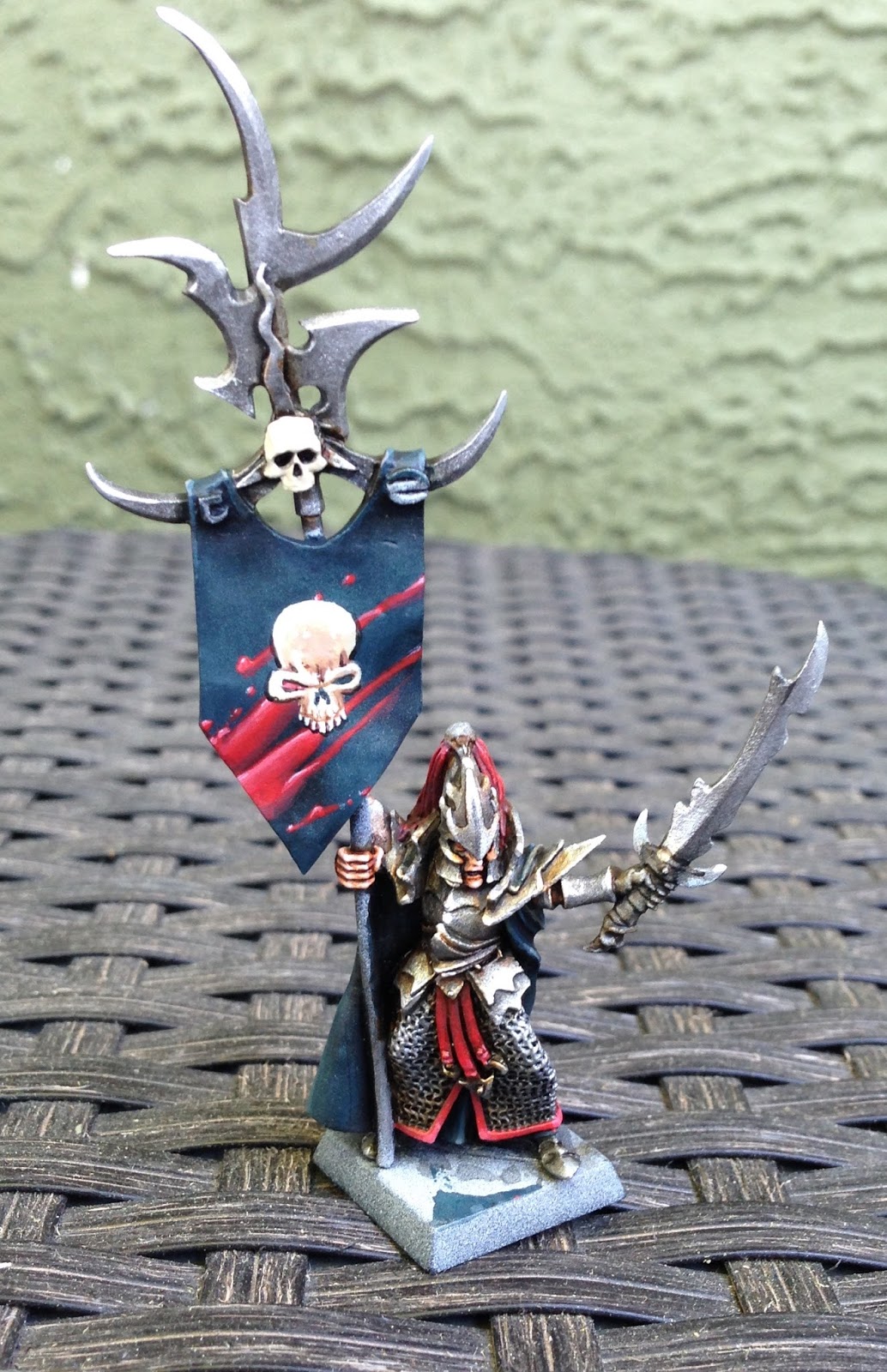
Dark Elf Standard Bearer of Khaine for Warhammer Fantasy / Age of Sigmar : The Blood Elves


I realize that it's been some time since I last posted anything up about any of my own personal works, so I thought that it would be nice to present a small project I did up last year.  I was helping to organize The Sable Shield painting competition at the Attack-X gaming convention (in Kamloops, B.C.), and my co-organizer and co-judge, Jillian Walker, had challenged me to a painting duel.

Now, I know I really struggle with finding the time, energy, and motivation to paint these days... with family, work, a new house to renovate, a big yard to tame, and a great kid that I love spending time with (might as well spend as much time as I can with him now, considering that he'll likely want to stay away from me when he's a teenager...), painting keeps getting pushed lower and lower on the "To-Do List".

But seeing as I was making the long drive out to Kamloops anyway, spending time working on many behind-the-scenes details and paperwork to try and make this painting competition a success, Jillian and I thought it would be a fun diversion from the work we were doing, and great motivation to get a small project done.  Now I just needed to get a mini done before the event, and do it up to such a standard so that it would look like crap next to the model she was bringing.

So, I had to decide on a single mini to paint.  I didn't have a whole lot of time, so I decided against doing anything too intricate, or with too much conversion work involved.  But I still needed it to be impressive... not just technically impressive, but pretty showy.  Many of the people viewing the minis were gamers first and foremost, and not hard-core miniature painters.  These guys might not appreciate technical difficulty or advanced miniature painting techniques... they were going to want to see the "ooh / aah" factor.  I needed to bring the bling.

I've been working on and off on a Dark Elf army for Warhammer Fantasy Battle for years.  I started playing Fantasy back in the early 90s with a High Elf army, won a few "Best Painted" awards with it, more importantly I won many a hard-fought game with it (Elves reward a finesse style of play, and brutally punish a sloppy or inattentive army general... I lost game after game at first, but after sticking with this army for several years, I got pretty good with it), and then sold it off sometime around 2000 to pay off some bills.  I really missed how that army played, looked, and how much fun it was to paint as well.  Not wanting to do up the same thing exactly, I decided to do up a Dark Elf army, which I'd only managed to paint up a few units and characters just before GW decided to wipe out the Old World and do Age of Sigmar instead (f*ck, don't get me started...).

The army needed an army standard bearer, and so I found this old Gary Morley sculpted mini.  I believe it was a regimental standard for some unit in the old range, but the oversized sculpt would make for a decent army standard bearer on foot.  He was posed very dramatically, and was a one piece sculpt (which I rather like to paint, as they are robust and hard to break, and there are no hard-to-reach areas to test your patience).  I'm not a huge fan of the sword as it's unnecessarily busy looking and looks rather impractical, but that's the way they did "Evil" weapons back in the day.  Changing it out would take time, and take away from the nostalgia factor.

The armour plates and sword would prove to be a challenge for my modest TMM (True Metallic Metallic) painting skills (see my previous article on TMM vs NMM for a description of how TMM works).  The cloak would be a good opportunity to practice my blending.  And the banner was going to be the main attraction... nothing impresses the masses like a good bit of freehand, and this banner had enough room for plenty of freehand.

Now, traditionally Dark Elves (the Warhammer Fantasy kind, not the TSR / WotC / Forgotten Realms sort) have been associated with blacks and purples.  They are very much signature colours for this particular race, and used by the Eavy Metal team and GW artists to excellent effect.  However, I had been playing the Warhammer Online MMO (Massive Multiplayer Online) game when it first came out, and my character on there was a Dark Elf war priest of Khaine... the bloody elven god of murder.  I wanted my army to work around the theme of a zealot army, single minded in their efforts to heap prayers and offerings to this god, and these offerings were going to be in the form of lots, and lots of bloodletting.

I give free hugs!

So, black and red was the theme.  Steel would be a neutral colour (essentially a metallic grey), and the occasional bits of bone, flesh, and leather to add organic colour touches here and there to offset all the bright red.

Anyway, I got started with a light coat of black primer, followed by an even lighter dusting of white.  The black gave the recesses of the mini much needed depth (remember, this is a relatively flat one piece mini), but the white coat over top would not reach those same recesses, and only settle on the higher points of the model.  This gave the model a black and white look, allowed me to see all the definition on the mini (which helped me plan the next stages), and any bright colours I laid down would have the brightness I needed for them to pop (black undercoats tend to dull down bright colours, white tend to make them brighter).


Fast forward to when I got all the colours down, using progressive drybrushing on the chainmail, blended TMM on the plate mail, sword, and banner topper, and push-pull blending and two-brush blending on the cloth areas.  Ink washes helped with blacklining to give it hard definition, and keep the viewer's eyes from blending each area into one another.  However, in order to tie the painting together a bit better, I worked in some earth coloured glazes into the recesses of the armour, which also gave the impression of how reflective polished armour would pick up the colour of the dirt around him.

I freehanded a skull and blood splash effect onto the banner.  However, it didn't turn out how I had hoped... somehow it didn't look impressive enough.  While sufficiently gaudy enough for a unit standard, it didn't suit something that would be carried into battle next to the army general him / herself.


After a quick look through some old Dark Elf army books, and the very neat iconography contained within, I came across a solution: add a spiky crown.  This gives the skull motif more height, adds a regal touch, and makes it much more menacing.


Now, despite the height of his banner, one thing that always makes a model stand out more in a display case (particularly one that is crammed full of other minis) is something to elevate it.  This way no other model will be obscuring yours.  It also gives it a bit bigger footprint in the figure case, gives it a visual border in much the same way as a nice frame does for a wall painting, and gives it a bit more breathing space /elbow room from the other miniatures.

Long ago, I had purchased a nice resin plinth from Secret Weapon Miniatures, and finally got to put it to good use.  The only problem was that it was a bit tall for this miniature, so I figured adding a bit more freehand on the front of it would help with that.  Not sure if it did, but it did give me another chance to show off some freehand skills.  I started it off with a simple skull.


While nice, it still needed a bit more punch.  So, in order to reinforce the blood theme, I thought it would be interesting to have it emerging from a pool of it.  I pulled up some blood ripple pics from Google for inspiration.


That one was interesting, and I could almost see the drop being where my skull would go.  But the ripple effect on that picture was a bit too chaotic, and not stylized enough.  I then found the following picture:


Much better.  I then painted in onto the plinth, and added a bit more reflective light bouncing off the waves.


Overall, not bad.  There was still a bit too much dead space above the blood and skull, but I had run out of time.  Not only did I need to get back to working on organizing the painting competition, but I was starting to run out of creative juices.  At some point, you just have to walk away from a miniature.  I could still return to it at a later point, but for now, it was done.  I never really get a feeling that a miniature is truly finished, but there is a natural point where it feels okay to leave it as-is.  After all, Leonardo da Vinci once famously said, "Art is never finished, only abandoned."

The miniature was well received with the Attack-X convention-goers.  Later, I entered it into the store painting competition at my local Games Workshop, and it placed first in the Fantasy / Age of Sigmar single miniature category.  I then entered it in the Vancouver IPMS Fall Show (while the name implies that they do a big show every season, they really only hold one big show a year which happens to be in the Fall).  While it did well in bringing home a ribbon, I believe it was beat out by my 40K assassins (you can enter multiple times in the same category at IPMS, so it's possible for one person to sweep all the top placings in a given category).

The best pic I have right now.  I really need to sit down and take some studio-quality pics of my miniatures.

All in all, a nice little project.  I have a tendency to overthink and over-plan my paintjobs, often spending much more time on the lead up to painting than I do on the painting itself.  Sometimes Google and Pinterest are your friends (in this case, Google helped with finding reference pictures for blood splatters and blood ripples), and other times you just get carried away with the research, and it eats away at time that would be better spent painting.

In this case, having a looming deadline and a clear vision of what I needed to get done helped rein all that in.  I only researched for as long as I needed to find an image that worked well enough (you never find "the perfect reference pic", no matter how long you spend trying).  And I stuck to a theme that I knew I could achieve, although it was still challenging enough to test and push my skills.

Well, let me know what you think.  As always, comments and criticism are welcome.  Right now, I've got a number of other projects on the go, but not enough time to spend painting.  I'll post up some WIP pics when I can.  I'm currently working on some Battletech mechs for one friend, some 40K Grey Knights for another, and if I can find the time, I would like to bust out some busts so that I can practice what I learned at Alfonso "Banshee" Giraldes' colour theory course, and Mathieu Fontaine's airbrush course.  And I have a Sisters of Battle army that needs some updating so that I can get some games of the new Warhammer 40,000 in... it just never ends, does it?  And that, in my opinion, is a very good thing.


Tuesday, 13 June 2017

Quick Tip: Using Matt Medium to Get Rid of Shiny Model Syndrome

Just a quick post on a valuable tip for getting rid of those stubborn shiny spots and finishes that even Dullcote matte sealer spray won't get rid of.

This is a fairly common problem for a number of painters.  Many times we'll paint a miniature, and either the washes come out glossy and shiny, or the paint itself inherently dries to a candy-like finish.  The common fix is to hit the model with a coat of matt sealer spray when it's done.  Not only does the sealer spray tone down the shininess, but it also gives the model a transparent protective coat that helps defend it against some minor wear and tear.

While I've used matte sealer from companies like Games Workshop, Privateer Press, Armoury, Ral Partha, Army Painter, and others, I keep coming back to Testor's Dullcote for the flattest finish of all of them.  My experience is that matte sealers from gaming companies are slightly more durable, but aren't quite as matte to the eye as ones from dedicated modelling companies (who aren't as concerned about durability).  Testor's Dullcote (which comes in fairly small cans) has earned quite the reputation from numerous painters as the go-to matte spray sealer when you have a model with a shiny finish that needs killing.


However, spray sealers have their weaknesses.  They often have a hard time reaching the deepest recesses of a model.  They often go glossy when we get heavy-handed with them.  Unless you mask off certain areas, they cover EVERYTHING on the model with the same finish (which stinks if you want your metallics to be shiny, and your gems to be glossy, but everything else to be flat).  They can give a cloudy finish if the can is not shaken well enough, spray from too far away on a hot day (the spray can dry before it even hits the model), or if you are spraying in the cold.  And often times, they just aren't matte enough to do the job, especially when the model is especially shiny.  What's a model painter to do, if this is the case?

Well, that's when matte medium comes to the rescue.  Normally, we use matte medium as a painting medium... which is to say that it's designed to be mixed in with our paints on the painting palette.  It's slightly cloudy when wet, but dries clear, and most importantly of all, it dries incredibly matte.  It's just the trick for thinning out your paints and inks, without getting the runny-ness of thinning with water alone (using water alone also dilutes the binders that make the pigments spread evenly, causing the colours to break up somewhat as you are painting).  Mixing a tiny bit of matte medium with the paint and water on your palette allows you to create weakly pigmented paints that are great for glazing and translucent layering, but still retaining enough body and thickness to retain easy control over where you are laying it down.

Amazing that something so flat, can come out of a bottle so round...

Years and years ago, shortly after I found some acrylic matte medium in the art stores (before they started showing up in gaming shops in the Vallejo miniature painting line), I thought of trying it out straight up, without mixing any paints in with it.  I was using inks quite heavily at the time, which were great for creating washes for shading.  However, inks have a tendency to dry very, very glossy.  This created quite a problem, as the recesses of my models were catching more ambient light than the highlighted raised detail!  The usual fix, spray matte sealer, wasn't doing a great job of countering this, as these were the areas that spray was least likely to reach as well.

I put some on my painting palette, thinned it with a tiny amount of water in order to get it to flow off the brush smoothly (it's a bit too thick straight from the pot), and then proceeded to lay it down like I would with a glaze (only this "glaze" was completely transparent when dry).  To my pleasant surprise, it worked like a charm.

By applying it by brush, I had a level of control I wouldn't have had with a spray can.  This was long before airbrushes really caught on in our hobby, and so I had to use a sable brush at the time.  I could place the matte sealer precisely where I wanted it, avoid areas I didn't want to dull down, and also control the consistency of the matte glaze.  And it dried MUCH flatter than any spray matte sealer out there... even more so than the much celebrated Testors Dullcote.

As with anything, there were some trade-offs.  It was more time-consuming than a rattle can, of course, but this wasn't something I would do on an entire unit or army anyway.  Also, if you brushed it on too quickly, or if it was watered down a bit too much, it would froth up and create bubbles on the miniature (this was fixed by brushing out the bubbles with a moist brush while the matte medium was still wet on the model... an easy but time-consuming fix).  And in many cases, a second coat was needed as any missed spots wouldn't show up until after the first coat dried completely.

One more thing to note is that matte sealer is matte because it has a very fine texture to it that disrupts any light from bouncing off it in a reflective manner.  Gloss sealer is glossy because it dries to a smooth, polished, mirror-like finish. If you are planning on putting any decals on AFTER using matte sealer, it's best to put down a layer of gloss sealer where you want the decal to go beforehand.  If you have a matte medium or matte spray underneath a decal, the decal will trap tiny air bubbles underneath it due to the rough pebbly surface of the matte sealer.  When dry, it will give your decal a "silvered" finish, which makes it extremely obvious that it's a decal, instead of giving the impression of something painted on.  After the decal is set, you can always apply matte sealer over top to kill any residual shine.

By the careful use and placement of brush-on matte medium, satin varnish, and gloss varnish, you can control the types of finish you want on every part of your model.  For example, you may use matte medium over the clothing, skin, etc., while using satin varnish over the metals, and gloss varnish over glass, eyes, and gems.  This allows you add another level of contrast and realism to your models.

This became such a staple and fundamental part of my miniature painting techniques, that I didn't realize that there were a number of painters out there that relied solely on spray matte sealer to kill shiny finishes.  The casual gamers that I hung out with didn't seem to mind this issue much, but more serious painters would.  It wasn't until I started blogging, and following other people's blogs, that I realized that there were any high level painters that didn't figure this out for themselves.

Two painters that I follow quite religiously are Dave Soper and Jarrett Lee.  Both have done what I never have, which is win Golden Demons, and in Mr. Soper's case, multiple Slayer Swords.  Dave struggled with a Dark Eldar diorama that he had applied some of the new GW washes on, and Jarrett had some Zombicide models that came out pretty glossy after washing them with inks.  In the comments section of their blogs, I suggested they try using Vallejo Matt Medium as a paint-on spot solution to their issues:

http://sproketsmallworld.blogspot.ca/2013/02/painting-third-scourge-part-2.html

http://minijunkie.blogspot.ca/2013/04/zombicide-first-set-of-walkers.html

http://minijunkie.blogspot.ca/2013/04/zombicide-josh-less-shiny.html

In both cases, this solution worked like a charm.  I even joked on Dave Soper's blog that I would now be able to take partial credit for any Slayer Swords he won from then on... and then he went on to win multiple Slayer Swords!

This is probably the closest I'll ever get to winning a Sword.  Sad, really.  :(

Anyway, I think is a good example of how even the best painters in the world never stop learning.  And that often the best tips come from newer or less experienced painters, who often come at an issue from a fresh perspective.


Saturday, 6 May 2017

Mathieu Fontaine Painting Masterclasses in Vancouver : Masterclass Painting and Airbrushing Classes!


I'm extremely excited to announce that Mathieu Fontaine will be coming to Vancouver to teach two courses : his classic Masterclass, and his brand new airbrush course.  I posted this up in a few local Facebook groups earlier, but somehow managed to forget to post this up on my blog as well!

Five years ago, I was totally burnt out on miniature painting after doing it for a living for over half a decade.  I had no passion for it any more, and couldn't even bear the thought of sitting in a chair and breaking out the brushes, despite having a closet full of miniatures in various states of completion.

Then it was announced that Mathieu Fontaine was coming to Vancouver to teach a set of painting Masterclasses, and I figured, "What the hell..." and signed up.  I have to say that it was the best thing that ever happened to my mini painting.  It demystified many of the techniques used by many of the top painters, gave me a whole new set of skills and techniques to work on, gifted me with a much more solid understanding of what makes some paintjobs work better than others, and most importantly, it made me extremely excited to paint again.

Mathieu brought this diorama along, and it was amazing to see "in the flesh"

For those people who are unfamiliar with Mathieu, he is an extremely accomplished painter from the province of Quebec (the primarily French speaking part of Canada).  And he is one of the "Game Changers" in the world of miniature painting, at least for North America.

Eons ago, miniature painting was dominated by the Eavy Metal style that was "perfected" by Games Workshop.  As I have mentioned before in a previous blog article, it's a fantastic method of painting for beginners and gamers, as it's simple and clean.  However, once you've reached the limits of what that style can accomplish, it's kind of an evolutionary dead end in terms of art.

However, GW was organizing it's proprietary "Games Day" conventions all across the world, with the "Golden Demons" painting competitions set within them.  It's a painting competition that draws the best of the best, due to all the coverage it attracts online and in print.  Win a Golden Demon, or better yet, the Slayer Sword (the "Best in Show" award for Games Day), and people all around the world would know about it.  And because of that, an interesting thing began to happen.

Different art styles were showing up at Golden Demons.  In particular, the continental Europeans (most notably in France, Spain, and Italy) were producing some of the most wondrously expressive paintjobs, accomplished with the highest levels of technical skill. And while we had our own Games Days / Golden Demons in Canada and the US, their stuff was making us look like we were painting with our fingers in elementary school.

Mathieu, and a few select Quebecois painters, managed to reach out to some of the best Euro painters and learn from them.  It was the supercharged injection that our painting scene direly needed.  From that, the standard of painting went up... way up.  Mathieu went on to become one of the winning-est miniature painters in the world (having won awards in both the New World and the Old).

For some examples of his works, check out some of the following links:

Mathieu's website : http://mathieufontaineminiatureart.com/

Mathieu on Putty and Paint : http://www.puttyandpaint.com/Akaranseth

Mathieu's Golden Demon winning entries : http://demonwinner.free.fr/peintre.php?id_peintre=1227

A 2014 interview with Mathieu : http://www.belloflostsouls.net/2014/08/miniature-painting-masters-mathieu-fontaine.html

Not only has Mathieu made his mark by winning all sorts of awards for his work, but he has also made his imprint on miniature painting by paying it forward.  He has been teaching miniature painting for years now, starting long before I took his class half a decade ago.

Now, I admit that first impressions of Mathieu can be a bit daunting.  He's a bit brusque, extremely opinionated, sarcastic to the extreme, and he never seems to pronounce the letter, "H" (in short, he's a shining example of Quebecois manliness).  But he's also a great friend to have, and a great source of insightful truth about art.  And if he starts to make fun of you, then you know that he is starting to like you.  He's kind of funny that way.  ;)

He has also gone on to paint for many private collectors worldwide, including a few models for George R.R. Martin (the author of The Game of Thrones).

For these reasons, I'm really happy to be able to play a small part in bringing him back to Vancouver.  As you all know, I love this city, and I would really love to make it a mecca of miniature painting.  The problem is that we are geographically and culturally far removed from the epicentres of the art form (the UK, France, Spain, Italy, mainly).  Thanks to the Internet, we get access to digital doses of the international painting scene, but it's still not the same as being there.  So it's great when we can bring people like Alfonso "Banshee" Giraldes here, or Meg Maples, or Mathieu.  Each Masterclass we have here noticeably elevates the painting locally.  It also inspires people to keep developing miniature painting as an art form.

So, for anyone who has been learning how to paint by watching YouTube videos, or reading White Dwarf magazine, or hanging out at their local game shop and slinging paint with their buddies, a Masterclass may be a daunting prospect.  But perhaps I can make an analogy here:

If you are a home cook... a pretty decent home cook, by all accounts... would you be content with staying at that level?  Would you still be having fun cooking years later, if you don't challenge yourself, and meet higher level chefs once in awhile?  Be exposed to some of the best cooking in the world?

Now say that you hear that Gordon Ramsey is coming to town to teach two weekends of cooking?  This is a Michelin star rated chef... perhaps one of the best in the world (certainly one of the best known).  And he's making time to teach a small class of students of all levels of experience, from beginner to expert, how he likes to cook.

Wouldn't THAT be a neat experience?  Inspiring, perhaps?  Possibly transform how you cook from now on?

Not to mention how FUN it might be?

I know I'm gushing more than a little bit.  Perhaps even being over-dramatic.  But I'm just trying to get my point across.  Painting is a journey, and one that is more interesting because of the people you meet along the way.  This is a great opportunity, and I'm really happy to help be a part of that.

If you are interested, email me at kellykim@bikerider.com , and I'll answer your questions, and fill in the details.  Your spot is not reserved until payment is received, and we do have a few spots left at the moment.

Hope to hear from you soon!